Pain

Pain: Nothing Works Always, Some Things Sometimes

Pain: Nothing Works Always, Some Things Sometimes

Anything can work some of the time. Nothing works all of the time. This phrase works really well to illustrate the complexity of working with pain. Pain is dependent on multiple, diverse, interacting variables. Pain is a perception due to the interplay of biological,...

read more
What Can Octopuses Teach Us About Pain and Consciousness?

What Can Octopuses Teach Us About Pain and Consciousness?

What would it be like if your arm had a mind of its own? Even stranger, if you had eight arms so ‘suffused with nervousness’ that they wander, explore and feel with their own goals, acting as ‘agents of their own’. This is the model offered for being an octopus in...

read more
Most pain is not a tissue issue

Most pain is not a tissue issue

Here's a big question for you: if you have pain in your big toe, is your pain in your big toe? Or is your pain inside of you?  We used to always think that the pain was in the big toe. That the issue was in the tissues. And that's useful to some extent – of course the...

read more
An unusual way of thinking about pain (new course)

An unusual way of thinking about pain (new course)

We used to think that pain was just about the tissues; we focused on operations, we focused on aligning things. But we now know that a huge contribution to our pain experiences is the stories we tell ourselves, and the stories we’re given by other people. The modern...

read more
Pain as a bad habit (new course)

Pain as a bad habit (new course)

 I want to explore a very powerful notion with you - that pain can be like a bad habit. At one stage the reflex to withdraw, to rest, to protect yourself from a difficult stimulus is important. For example, if you twist your ankle, you do need to rest and protect so...

read more
How can TRE® help manage auto-immune conditions?

How can TRE® help manage auto-immune conditions?

This article was written by Sylvia Benoist. (Note from Steve: Sylvia recently completed her training as a TRE - Tension and Trauma Releasing Exercises - supervisor (mentor with me), and I asked her to share her journey with TRE and Ankylosing Spondylitis, a type of...

read more
How to Make Your Brain Feel Safer?

How to Make Your Brain Feel Safer?

There is a lot of pain around: In a huge study (Breivik et al 2006) across 15 European countries, 19% of people reported living with moderate to severe pain for more than 6 months. That’s 1 in 5 people in persistent pain states, the majority for many years. Holy moly....

read more
Can we change the way we perceive pain?

Can we change the way we perceive pain?

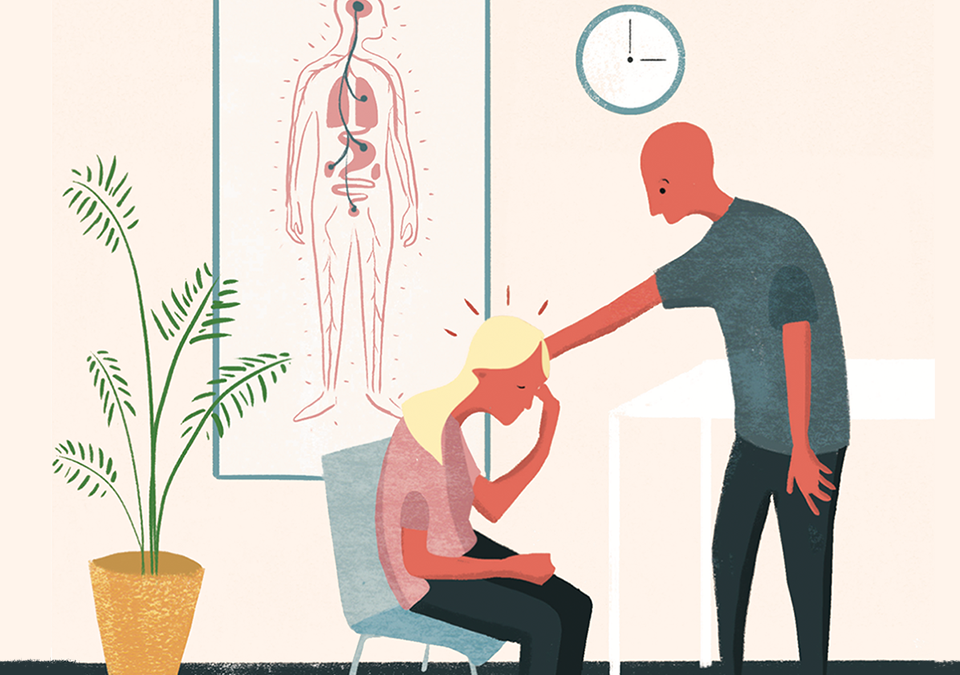
Pain is strange in that it is non-linear and quickly becomes amplified over and above what is happening in the tissues.  A leading definition emerging from the latest research is that pain emerges when your brain decides something is unsafe.  At the core of the...
read more
You’re an organic garden, not a broken machine

You’re an organic garden, not a broken machine

When it comes to working with pain, I believe the core of our clinical work is finding creative ways to help people find agency, strength and choice.  In my early work, I used to believe there was a stretch or a manipulation for every health challenge. Over time I...

read more

Touch Is Really Strange – New April 2021

About Touch Is Really Strange When did you start working on the book? The idea for a book on touch has been in my head since 2019, but definitely a lockdown project. The Really Strange series has been huge fun and continues to get heartwarming feedback. There have...

read more
The Brain Can Make Mistakes When it Comes to Pain

The Brain Can Make Mistakes When it Comes to Pain

When I teach that “pain involves the brain,” people often feel that I’m saying that it’s their fault. That’s really not what I am saying. I like to talk about the mind, the brain, and the body. The mind is our consciousness, our awareness, our sense of self. The brain...

read more